
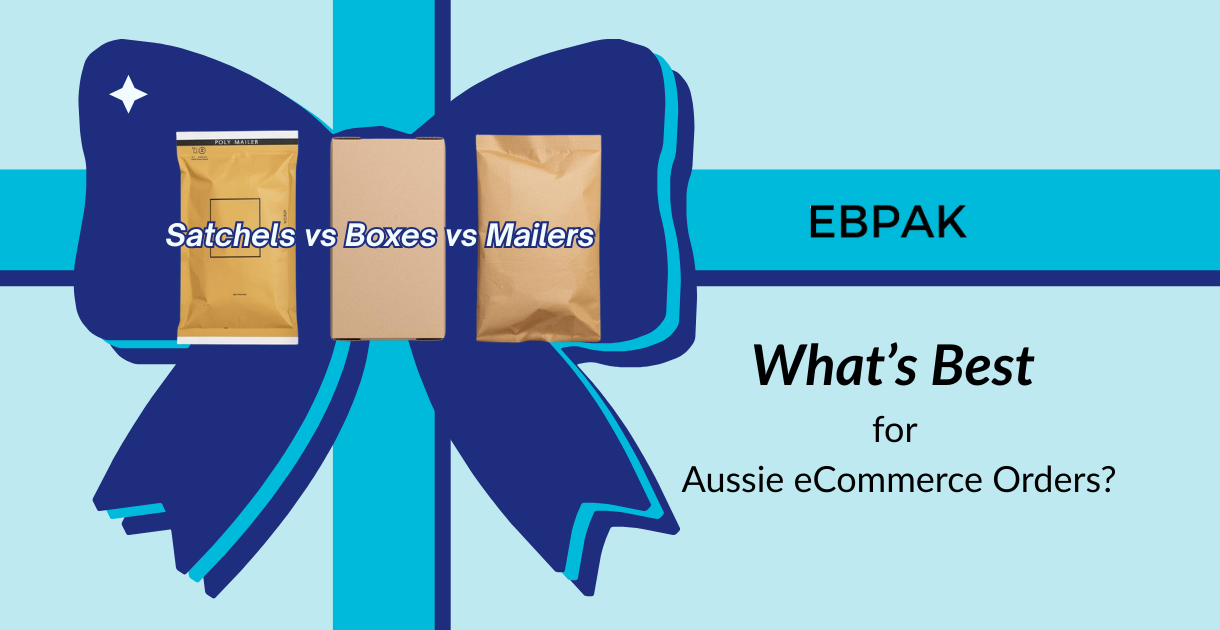
If you run an Australian online store, you’ve probably asked yourself at some point ‘what is the difference between satchels vs boxes vs mailers?’ and what’s actually best for your orders.
At eBPak, we speak to eCommerce brands every day who are trying to strike the right balance between cost, protection, presentation, and packing speed. The truth of the matter is that there's no one-size-fits-all answer.
The right packaging depends on what you’re shipping, how far it’s travelling, and how you want your brand to show up at the customer’s door.
In this guide, we’ll break down the best packaging for eCommerce orders, reduce the confusion, and give you a simple framework to standardise your packaging decisions.
First Things First: Match the Packaging to the Product
Before you compare costs or courier rates, start with the product itself.
Use Satchels or Mailers for Non-Fragile Soft Goods
If you’re shipping items such as clothing, accessories, stationary, soft homewares, lightweight and non-breakable items, then mailers or courier satchels are often your most efficient option.
Mailers and courier satchels are both lightweight packaging solutions, but mailers (such as padded or poly mailers) are typically single-use and sent through postal systems. Courier satchels are often more durable, tamper-evident, and typically used by courier companies for secure, trackable deliveries.
For brands focused on packaging for clothing eCommerce, poly mailers and padded mailers, such as our premium quality BubblePRO Bubble Mailer 01 160 x 230mm White with Address Lines, are typically ideal. They’re lightweight, shockproof, flexible, tear resistant and easily reduce dead space. That flexibility matters as couriers often calculate pricing based on dimensional weight.
Courier satchels, for online stores are especially useful when:
-
The item can’t break.
-
The product isn’t high value.
-
You want fast packing times.
-
You’re shipping high order volumes.
These satchels, like our customer favourite Poly Mailer 255mm x 330mm 02 Mailing Satchel White, or the reliable and FBA compliant Self Seal Poly Bag 254mm x 330mm Suffocation Warning for Amazon FBA, are quick to seal, highly secure, easy to label, and efficient to store in your warehouse or home office.
Use Boxes for Fragile, Heavy or High-Value Items
On the other hand, boxes (like our signature, best selling 430 x 305 x 140mm A3 Regular Brown Shipping Carton B936) are the go-to solution when protection is critical. You need structure If you’re shipping:
-
Glassware.
-
Electronics.
-
Ceramics.
-
Heavy items.
-
Premium or high-value goods.
Boxes provide rigidity and crush resistance that mailers or satchels simply can’t match.
For businesses focused on packaging for fragile items in Australia or globally, corrugated boxes combined with void fill (like bubble wrap, or eco-friendly alternatives) dramatically reduce the risk of damage in transit.
The Hidden Cost: Shipping Impact Beyond Just Packaging Price
Volumetric (Cubic) Weight Matters
Australian couriers typically charge based on whichever is greater between actual weight of the item, or volumetric weight (in other words, how much space the package takes up in delivery).
Boxes with too much empty space increase its cubic weight, even if the item itself is light.
For instance, a lightweight jumper in a large box could cost more to ship than the same jumper packed in a satchel, because of cubic pricing.
This is why, for soft goods, mailers or satchels often win compared to boxes, at least from a shipping cost perspective.
Dead Space is Wasted Money
If you’re using a box significantly larger than the product, you’re paying to ship air. Standardising box sizes helps, but choosing the right format altogether is even better.
When evaluating when to use mailers vs boxes, ask:
-
Does the item need rigid protection?
-
Or can flexible packaging reduce space and cost?
Small changes here can dramatically impact your shipping margins over many orders, long-term.
Protection vs Presentation: You Don’t Have to Choose One
There’s a misconception that boxes automatically equal better branding. Not necessarily.
Yes, boxes can create a premium unboxing experience. But presentation isn’t just about the outer shell; it’s about the overall experience. The key is balancing protection and presentation.
As an example, If you sell affordable fashion basics, a branded mailer may be perfectly aligned with your brand and price point. It wouldn't make sense to use a box in this situation.
On the other hand, If you sell premium skincare sets or electronics, a well-fitted branded box reinforces value and reduces risk.
Boxes like our popular 220 x 160 x 77mm A5 Die cut White Mailing Box B38 or similar standout 220 x 160 x 77mm A5 Premium Tuck Full Black Mailing Box B195 are commonly used within those industries as part of elevating the customer experience, especially if the products or brand image is synonymous with a luxurious, high-end or exclusive identity.
At eBPak, we offer an extensive selection of boxes and cartons in a variety of shapes, sizes, and styles to ensure the perfect match for your specific needs.
Ultimately, the best packaging for eCommerce orders is the one that most appropriately protects the product and supports your brand positioning.
Fulfilment Speed & Storage Efficiency
Packaging decisions don’t just affect shipping costs, they affect your daily operations.
Packing Speed
If you’re fulfilling high volumes, satchels and mailers are typically faster. Unlike boxes, they don't require as much assembly since they are often self sealing and do not need additional protective measures like taping or void fill.
Storage Space
When comparing satchels vs boxes vs mailers, consider not just what happens after dispatch, but what happens in your stockroom.
Mailers and satchels:
-
Take up minimal warehouse space.
-
Easier for home-based businesses.
-
Can come in clear bags, making it easier to identify packed goods or to rectify errors.
Boxes:
-
Can store flat but may require more storage area in general.
-
May increase overhead if space is tight.
-
Sustainable and recyclable material.
A Simple Decision Framework for Aussie eCommerce Brands
This framework helps standardise decisions across your team, so you’re not making packaging calls order-by-order. To remove guesswork, we recommend using the following framework based on these five factors:
Fragility
-
Fragile: Box
-
Non-fragile: Mailer or satchel
Size
-
Bulky or structured: Box
-
Compressible or flexible: Mailer or satchel
Weight
-
Heavy items: Box
-
Lightweight items: Mailer or satchel
Value
-
High-value products: Box
-
Lower-value products: Mailer or satchel
Delivery Distance
-
Long-distance or more transit touchpoints: Box
-
Shorter distances or less transit touchpoints: Mailer or satchel
So, What’s Actually “Best”?
The best packaging for eCommerce orders is the one that:
-
Protects the product appropriately.
-
Minimises shipping and dimensional weight costs.
-
Speeds up fulfilment.
-
Fits your storage space.
-
Delivers a positive customer experience.
For many Australian brands, the ideal setup isn’t choosing one; it’s using a smart combination of all three, depending on the product category.
If you’re unsure whether your current setup is as effective as it can be, it’s worth reviewing your packaging strategy and processes.
Need Help Choosing the Right Packaging?
At eBPak, we help Australian eCommerce brands simplify their packaging decisions every day. Whether you need:
-
Courier satchels for online stores.
-
Durable boxes for fragile products.
-
Cost-effective mailers.
-
Bulk wholesale packaging supplies.
-
High Quality yet affordable packaging solutions.
Our team can help you find the right fit based on your product range, shipping profile, and budget.
Get in touch with us at eBPak today to optimise your packaging strategy and order the right supplies with confidence.