
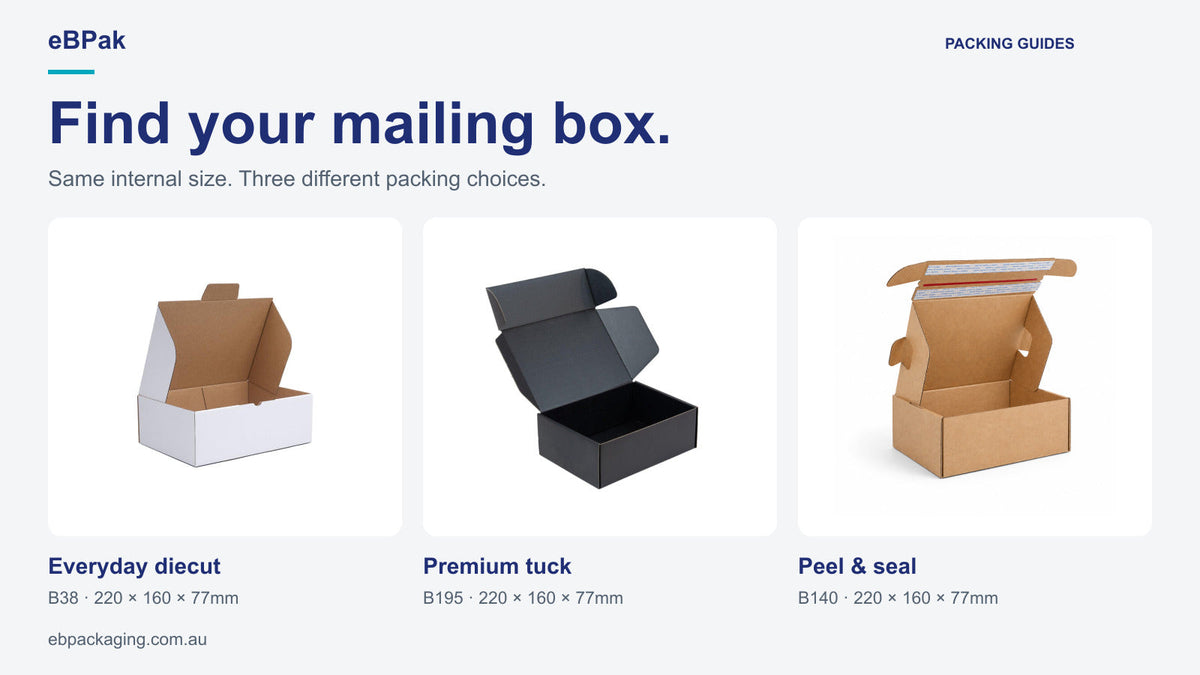
The right mailing box needs to fit your product, hold it securely and suit the way you pack. Here is how to choose between everyday diecut mailers, premium tuck-front boxes and peel-and-seal boxes, using real products from the eBPak range.
Start with the terminology. “Diecut” describes how the board is cut and creased. “Tuck front” describes how the lid closes. A tuck-front box can also be diecut, and a self-seal box can have a tuck-front lid. These are overlapping features, so compare the actual construction and closure.
Which mailing box suits your order?
| Option | How it closes | A useful starting point for | Check before sending |
|---|---|---|---|
| Everyday diecut mailer | Folded walls and locking lid tabs | Stationery, accessories and everyday retail orders | Secure the lid for transit; allow space for protection. |
| Premium tuck-front mailer | Front flap tucks neatly inside | Gift sets, presentation packs and subscription orders | A neat tuck closure still needs a suitable transit seal. |
| Self-seal mailer | Built-in peel-and-seal adhesive | Dispatch benches that want to remove the separate taping step | Check the number of seal strips and press the adhesive firmly. |
| Regular slotted carton | Top and bottom flaps closed with tape | Larger orders or products needing a different board grade | Choose the board strength and cushioning for the actual load. |
A closure style alone does not tell you how much weight a box can carry. Product shape, board grade, cushioning and the shipping journey all matter. Heavy or fragile items need a suitable protective pack, even when presentation is important.
Three real boxes, one internal size
These three eBPak products all measure 220 × 160 × 77mm internally. That makes them useful options to compare when you want the same item fit with a different finish or sealing method. Photographs are for product identification and are not shown to scale.

Everyday white diecut
B38
220 × 160 × 77mm internal
White outside, brown inside. E-flute corrugated board with tuck-in locking tabs. A practical base for a shipping label or brand sticker.

Premium full black tuck
B195
220 × 160 × 77mm internal
Black inside and out, with a matte finish. The side walls and front flap fold double for a finished presentation.

Brown self-seal
B140
220 × 160 × 77mm internal
Kraft board with a tuck-front lid. One adhesive strip sends the order; a second covered strip can reseal it for a return.
Need another format? Compare the diecut range, premium tuck range and self-seal range. Check each listing for its dimensions, finish and pack quantity.
How to choose the right box size
- Prepare the item as it will travel. Include its retail pack, inner wrapping and any inserts.
- Measure length × width × height. Use the complete packed item, rather than just the bare product.
- Allow space for the protective material. Choose the cushioning for the product first. A fragile item may need much more clearance than a notebook.
- Check internal dimensions for fit. Then measure the sealed box externally when calculating shipping or checking a carrier’s size limits.
Worked example: a non-fragile retail pack measuring 200 × 140 × 50mm leaves a total of 20mm in length, 20mm in width and 27mm in height inside a 220 × 160 × 77mm box. If centred, that is only 10mm on each side. Check that your chosen wrap fits and the lid closes without pressure. This is a fit calculation, not a cushioning recommendation for breakable goods.
A box that is too tight can bow or press on the product. A box that is too large needs more void fill and lets the item move unless it is restrained. Test the assembled pack before ordering in volume.
Pack and seal for the journey
- Form the box fully. Fold the side walls and seat the locking tabs before loading it.
- Protect and restrain the contents. Wrap vulnerable surfaces and fill empty spaces so items do not knock against one another.
- Close the lid without forcing it. Bulging panels or tabs under strain mean the pack needs a different size or layout.
- Secure the closure. Use appropriate packing tape or a suitable sealing label on a non-adhesive mailer. A decorative sticker is not automatically a transit seal.
- For self-seal boxes, keep the bonding surface clean and dry. Peel the outbound liner, close the lid squarely and press along the full strip. Leave a separate return strip covered.
- Label a flat panel. Keep the barcode away from corners, folds and the opening seam.

Compare the cost of a packed order
The lowest box price is only one part of the decision. Compare the box, tape or seals, protective material, packing time and shipping cost for the same order. Use the same pack quantity when comparing unit prices, and measure the finished parcel rather than assuming two boxes with the same internal size cost the same to ship.
Run a small bench trial: pack several typical orders in each option, record the time and materials used, and inspect the sealed packs. For example, a measured saving of 20 seconds across 100 orders would save about 33 minutes. That is an illustration of the calculation, not a claim about a particular box.
Common questions
Are tuck-front boxes different from diecut boxes?
Tuck front is a closure style; diecut is a manufacturing method. Many tuck-front mailers are diecut. In this guide, “premium tuck” refers to the presentation-focused products in that eBPak collection.
Do self-seal boxes need tape for returns?
The B140 shown here has a second strip for resealing a return. Other products may have a different arrangement, so check their specifications. The box must still be in suitable condition for another journey.
Does an A5 or A4 label guarantee my item fits?
No. Those labels are useful starting points. Compare all three internal measurements with the wrapped item, including its depth.
Will a mailing box protect glass or heavy goods?
A box alone is not a complete protective pack. Choose a suitable board grade and cushioning, separate breakable items and test the finished pack. Ask for help if you are unsure which construction suits the load.
Choose with your actual product
Compare mailing boxes and cartons by size and closure, then test-pack before buying in bulk. For help, contact eBPak with your item’s packed dimensions, weight and order quantity.