
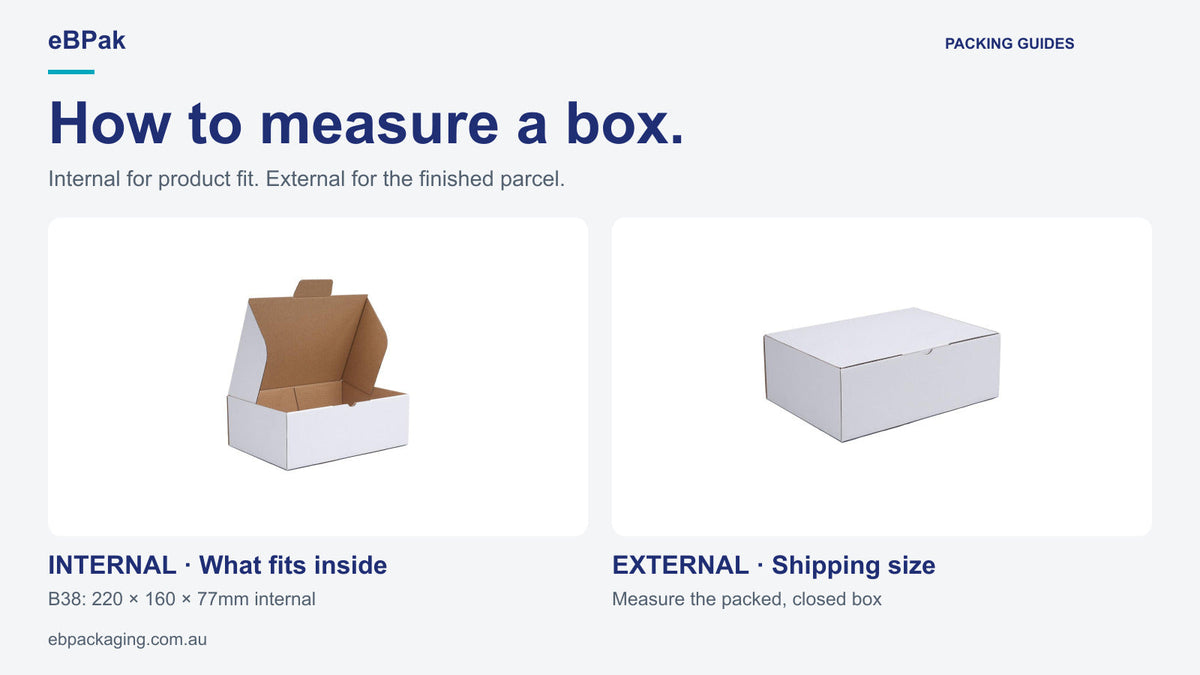
Use internal dimensions to choose a box that fits your product. Use external dimensions to measure the finished parcel for shipping or storage. Keeping those two measurements separate helps you avoid a tight fit, wasted packing space and inaccurate shipping quotes.
The quick rule: measure inside for product fit; measure outside after packing and sealing. Do not calculate the outside size simply by adding a few millimetres to the product listing.
What does length × width × height mean?
For a conventional top-opening box, length (L) is the longer side of the opening, width (W) is the shorter side, and height (H) runs from the base to the lid’s closing position. Height is sometimes called depth. Check the listing or drawing if a supplier uses a different convention, especially for long or upright boxes.
For example, the eBPak B38 white diecut mailing box lists 220 × 160 × 77mm internal dimensions:
Write the units beside the figures. This same size is 22 × 16 × 7.7cm; 1cm equals 10mm. When reordering, record the product code as well as the dimensions so you can match the style and opening.
Internal versus external: one box, two jobs
The photos below show the actual B38 box open and closed. Its white exterior, brown interior and folded panels make it easy to see why the usable space and the outer envelope are different.
Internal: will the item fit?
Measure the clear space between the inside surfaces. Compare it with the product and its protective packaging.

External: how large is the parcel?
Measure the outside of the packed, closed box. Include the widest points and any outer packaging.

Corrugated board takes up space. Folded side walls, overlapping panels and the closure can add different amounts in different directions. Board thickness alone does not give a reliable internal-to-external conversion for every box design.
Internal measurements answer “will it fit inside?” External measurements answer “will it fit on this shelf, inside this outer pack, or within this shipping service’s limits?” For a close fit, check a sample rather than relying on a nominal size.
How to measure the inside of an existing box
- Assemble it completely. Seat the locking tabs and fold the internal panels into their working positions. Use a rigid ruler or a tape measure held straight.
- Measure length inside wall to inside wall. Measure across the longer side of the opening, keeping the ruler level rather than running it diagonally.
- Measure width the same way. Use the shorter side of the opening. Check for folded panels that reduce the clearance.
- Measure usable height. Measure from the inside base to the underside of the lid in its closed position. With the lid open, identify that closing plane; do not measure to the tip of an upright lid or flap.
- Check the fit at the narrow points. Measure in more than one place if the walls bow or taper. Make sure the item can pass through the opening as well as sit in the base.

Add packing space on both sides
First measure the product in its shipping arrangement, including its retail pack, handles, lids or anything that protrudes. Then add the space required by your chosen insert, wrap or cushioning on both opposite sides of each dimension.
Worked fit example: suppose a non-fragile retail pack measures 180 × 120 × 40mm, and your chosen insert needs 15mm on each side. The minimum internal space for that arrangement is:
Swipe the table sideways to see all columns.
| Dimension | Product + packing on both sides | Required internal space |
|---|---|---|
| Length | 180 + 15 + 15mm | 210mm |
| Width | 120 + 15 + 15mm | 150mm |
| Height | 40 + 15 + 15mm | 70mm |
The B38’s 220 × 160 × 77mm internal size exceeds that calculated requirement by 10mm in length, 10mm in width and 7mm in height in total. Test the insert and product together to confirm they load comfortably and the lid closes without pressure.
This is a space calculation, not a recommended cushioning thickness for fragile goods. Choose protection for the actual product and journey, then measure the resulting pack. Glass, ceramics and other breakable items may need a different insert, more cushioning or a stronger box.
If an item only fits when you force the lid down, it needs a different arrangement or a larger box. If it moves around, use an appropriate insert or void fill rather than assuming a larger box automatically protects it better.
How to measure the finished parcel
- Pack the order fully. Include all protective material and anything that will travel with the product.
- Close and seal the box normally. Do not squeeze the walls inward to produce a smaller reading.
- Measure each outside dimension at its maximum points. Include bulging panels, protrusions and any additional outer packaging. A straight edge can help you locate the furthest points.
- Weigh the complete parcel. The shipping weight includes the box, product, inserts and other packing materials.
- Enter the units your carrier requests. Follow that service’s rounding and size rules. Carrier length conventions may use the parcel’s longest overall side, which can differ from the opening-based notation on a box listing.
Why the outside measurements affect cubic weight
Cubic weight represents the space a parcel occupies. Australia Post’s cubic-weight guidance uses a conversion factor of 250kg per cubic metre:
External length (m) × width (m) × height (m) × 250 = cubic weight (kg)
For an example parcel measuring 400 × 300 × 200mm externally:
0.4 × 0.3 × 0.2 × 250 = 6kg cubic weight.
Those are hypothetical parcel measurements, not the external dimensions of the B38. Whether cubic weight affects the price depends on the service, packaging and account conditions; eligible flat-rate packaging is treated differently. Check Australia Post’s current size and weight guidelines, or your own carrier’s rules, before booking.
Packing-bench checklist
- Record L × W × H with units, the product code and whether the figures are internal or external.
- Compare the wrapped item and inserts with the internal space.
- Count packing allowances on both sides.
- Check that the item passes through the opening and the lid closes without strain.
- Use finished external measurements and packed weight for the shipping booking.
- Test a sample pack before ordering a large quantity.
Can I calculate the external size from the internal size?
Not reliably without the box’s construction details. Use a verified external specification or measure a packed, closed sample. Folded walls and overlapping panels make a single “add this much” rule unreliable.
Does “A5 box” mean every A5 product fits?
No. A paper-size label is a starting point. Check all three internal dimensions against the complete item, including binding, retail packaging and any wrap.
Is the size of a flat blank useful for reordering?
The blank can help identify the design, but quote the assembled internal size, product code and style when matching a box. A photograph of the open and closed sample also helps.
Find a box that fits your pack
Start with the B38 white A5 mailer or browse all mailing boxes and cartons. Compare closures in our mailing-box buying guide. For help, contact eBPak with the item’s packed dimensions, weight, protection requirements and quantity.